Category: Fixed Games

Here, at Fixed Games Global every match is a pulse-pounding opportunity, every fixed match a chance to strike gold. From the roar of the crowd to the adrenaline

Types of Soccer Betting Platforms: 2026 Bettor’s Guide

The four types of soccer betting platforms available in 2026 are state-licensed regulated sportsbooks, offshore sportsbooks, CFTC-regulated prediction markets, and decentralized crypto-native prediction markets. Each category operates under a different legal framework, charges different fees, and serves a different bettor profile. Platforms like DraftKings, BetOnline, Kalshi, and Polymarket represent these four categories respectively. Knowing which type fits your goals is the single most important decision you make before placing a dollar on a soccer match. This guide breaks down every category with real numbers, real trade-offs, and zero fluff.

1. Types of soccer betting platforms: the four main categories

Soccer bettors in 2026 choose from four distinct platform types: state-licensed regulated sportsbooks, offshore sportsbooks, CFTC-regulated event contract exchanges, and crypto-native decentralized prediction markets. Each type differs in licensing jurisdiction, settlement method, fee structure, and the legal protections it extends to you as a bettor. The right choice depends on where you live, how much you want to bet, and how comfortable you are with regulatory gray areas. Understanding these differences upfront saves you from costly mistakes later.

The core bet types available across almost all platforms include total goals, money lines, and player props, with market depth varying significantly by platform type. Regulated sportsbooks offer the most polished user experience. Offshore books offer sharper odds. Prediction markets offer something entirely different: peer-to-peer event contract trading with no traditional bookmaker margin.

Overhead view of soccer bet types on paper

2. State-licensed regulated sportsbooks

State-licensed regulated sportsbooks are the safest and most consumer-protected option for US bettors. Platforms like DraftKings, FanDuel, Caesars, and BetMGM operate under state gaming commission licenses and are legally available in approximately 38 US states as of May 2026. Full KYC verification is required, and your funds are protected under state regulatory frameworks. These are the online soccer betting sites most recreational bettors start with, and for good reason.

The trade-off is cost. Regulated sportsbooks charge higher vig of 5 to 8%, and they impose aggressive winner limits on sharp bettors. Tax burdens for regulated operators can reach 51% in some states, and those costs get passed directly to you through tighter lines. The soccer prop markets are also thinner than what offshore books offer, especially for lower-tier leagues like the Championship or Ligue 2.

Key features of regulated sportsbooks:

  • Legal certainty: Licensed under state gaming commissions with full consumer protections
  • Platform quality: Polished mobile apps from DraftKings, FanDuel, and Caesars with live betting interfaces
  • Payment options: Credit cards, PayPal, bank transfers, and Play+ cards all accepted
  • Soccer market depth: Strong coverage of Premier League, Champions League, MLS, and World Cup markets
  • Limits: Lower max bet limits compared to offshore alternatives, especially for sharp players

Pro Tip: If you are new to soccer betting, start with DraftKings or FanDuel. Their welcome bonuses, app quality, and customer support make the learning curve much shorter than any offshore alternative.

3. Offshore sportsbooks: access, advantages, and risks

Offshore sportsbooks are licensed in foreign jurisdictions like Costa Rica, Curaçao, and Panama, and they operate across all 50 US states in a legal gray area. Platforms like BetOnline, Bovada, BookMaker, and MyBookie have operated reliably for 15 or more years, building reputations as trusted options for sharp bettors and futures players who need better lines and higher limits. They are not licensed by US state regulators, which means no state-level consumer protections apply. That said, the top offshore books have survived regulatory and market shocks that eliminated weaker competitors.

The financial case for offshore books is real. These platforms charge lower vig of 3 to 5% and accept larger bets without restricting winning accounts. Crypto payments via Bitcoin and Ethereum allow faster withdrawals, often within hours rather than days. Soccer prop menus are deeper, covering player assists, shot totals, and corner counts across dozens of leagues that regulated books ignore entirely.

Key features of offshore sportsbooks:

  • Odds value: Lower vig means more money stays in your pocket over time
  • Betting limits: Higher maximum bets, especially on futures and major match lines
  • Crypto payments: Bitcoin, Ethereum, and stablecoin deposits with fast withdrawals
  • Market coverage: Broader soccer prop menus including lower-tier European and South American leagues
  • Risk factor: No US regulatory oversight, so platform reputation and track record matter enormously

Pro Tip: Stick to established offshore books with 10-plus years of operation and documented payout histories. Avoid any new offshore site offering unusually large bonuses with no verifiable track record. The bonus is never worth the withdrawal risk.

4. Regulated prediction markets for soccer in the US

Regulated prediction markets are a genuinely different category of betting platform, and most soccer bettors have not explored them yet. Platforms like Kalshi, DraftKings Predictions, and Robinhood event contracts operate as CFTC-regulated exchanges where you trade event contracts peer-to-peer rather than betting against a bookmaker. A federal appeals court ruling in 2026 confirmed CFTC jurisdiction over sports event contracts, giving platforms like Kalshi full legal clarity as a regulated exchange. This is a significant distinction from both sportsbooks and offshore operators.

The fee structure is attractive. Kalshi charges approximately 2% in trading fees, well below the 5 to 8% vig on regulated sportsbooks. Settlement is automated via exchange mechanisms, removing the bookmaker entirely. The limitation is liquidity. Live and in-play soccer markets on prediction exchanges are thinner than on traditional sportsbooks, which makes large position sizes harder to execute cleanly.

FeatureRegulated prediction marketsRegulated sportsbooks
RegulatorCFTCState gaming commissions
Fee structure~2% trading fee5-8% vig
SettlementAutomated event contractBookmaker fixed odds
KYC requiredYesYes
Live market depthLimitedStrong
API accessAvailableEmerging

Prediction markets also offer API access for programmatic trading, making them the preferred platform type for developers and quantitative bettors building automated systems. For compliance-conscious bettors who want legal certainty and lower fees, Kalshi is the strongest option in this category.

5. Decentralized crypto-native prediction market platforms

Decentralized prediction markets operate on blockchain infrastructure with no central authority controlling outcomes or funds. Polymarket is the most prominent example, using USDC settlement and UMA oracle smart contracts to resolve soccer event contracts without a centralized counterparty. Augur pioneered this model, and Crypto.com has expanded into similar territory. These platforms offer permissionless global access, meaning anyone with a crypto wallet can participate without identity verification on the global version.

The US version of Polymarket follows CFTC guidelines and does require KYC, but the global platform remains open. Trading fees run approximately 2%, and the order-book style liquidity model means prices are set by market participants rather than a bookmaker. This creates genuine price discovery and occasional arbitrage opportunities for sophisticated bettors.

Key features of decentralized prediction markets:

  • Access model: Permissionless globally, with CFTC-compliant US version requiring KYC
  • Settlement: Smart contract automation via UMA oracles, no human intervention
  • Currency: USDC stablecoin deposits and withdrawals, no fiat options
  • Fees: Approximately 2% trading costs, competitive with regulated prediction markets
  • Liquidity risk: Thinner markets than sportsbooks, especially for niche soccer events
  • Best for: Crypto-native bettors, agent operators, and traders comfortable with blockchain mechanics

The main risk on decentralized platforms is liquidity. Major tournament markets like the World Cup or Champions League final attract solid volume, but regular season Premier League matches or MLS games may have spreads too wide to execute efficiently. Know your market before committing size.

6. Side-by-side comparison and recommendations by bettor profile

Choosing between platform types comes down to three factors: your legal comfort level, your betting volume, and your priority between odds value and consumer protection. Odds-shopping tools can now overlay live prices across 75-plus sportsbooks simultaneously, making it practical to hold accounts on multiple platform types and always take the best available line. Using multiple accounts to shop lines across platforms increases expected value even when the underlying market is identical.

Platform typeLegality (US)Vig/feesBetting limitsKYCBest for
Regulated sportsbooksLegal in 38 states5-8%Moderate, winner limitsYesRecreational bettors
Offshore sportsbooksLegal gray area3-5%HighMinimalSharp bettors, high volume
Regulated prediction marketsFederally legal (CFTC)~2%ModerateYesCompliance-focused, developers
Decentralized crypto platformsVaries by jurisdiction~2%VariableNo (global) / Yes (US)Crypto-native traders

Odds index databases like Oddspedia scan 348-plus bookmakers for best-odds lists and line movement analysis, which is critical for soccer where lines shift quickly around team news and injury updates. Recreational US bettors should start with DraftKings or FanDuel. Sharp bettors with higher volume should add BetOnline or BookMaker for better lines. Developers and quantitative traders should explore Kalshi’s API. Crypto-native users will find Polymarket the most natural fit.

Pro Tip: Hold accounts on at least two platform types simultaneously. The price difference between a regulated sportsbook and an offshore book on the same Champions League match can be significant enough to matter over a full season of betting.

Key takeaways

The most effective approach to soccer betting platforms is matching your platform type to your bettor profile, legal situation, and fee tolerance rather than defaulting to one provider.

PointDetails
Four platform types existRegulated sportsbooks, offshore books, CFTC prediction markets, and crypto platforms each serve different needs.
Vig determines long-term costOffshore books (3-5%) and prediction markets (~2%) cost less per bet than regulated sportsbooks (5-8%).
Legal clarity varies significantlyRegulated sportsbooks and Kalshi offer the strongest US legal protections; offshore and crypto platforms do not.
Multi-platform strategy winsHolding accounts across platform types and shopping lines with tools like Oddspedia increases expected value.
Liquidity limits prediction marketsKalshi and Polymarket offer lower fees but thinner live soccer markets compared to traditional sportsbooks.

My honest take on picking the right soccer betting platform

I have spent years watching bettors make the same mistake: they pick one platform and stick with it forever, leaving real money on the table. The regulated sportsbooks like DraftKings and FanDuel are the right starting point. The apps are clean, the customer support is real, and the legal protection matters when something goes wrong. But once you are comfortable, ignoring offshore books like BetOnline or BookMaker is a financial mistake. The line difference on a single Champions League semifinal can be half a goal or 15 cents on the money line. That adds up fast over a season.

Prediction markets are the most underused tool in a serious bettor’s kit. Kalshi’s 2% fee structure and CFTC oversight make it genuinely compelling for anyone who bets on tournament futures or match winners. The liquidity is not there yet for live betting, but for pre-match positions on major soccer events, the pricing is often sharper than what you find at a traditional book. I would not rely on decentralized platforms like Polymarket as a primary betting home unless you are already deep in crypto. The UX is unfamiliar, the liquidity is inconsistent, and the learning curve is real.

The one thing I tell every bettor: use odds comparison tools before every single bet. The best platform for any given match is the one with the best price on that day. No single platform wins that competition consistently.

— Thomas

Get verified soccer predictions from Fixedmatch-house

Knowing your platform type is only half the equation. The other half is knowing which matches to bet on and with what confidence. Fixedmatch-house delivers 100% verified soccer betting predictions backed by insider contacts inside professional football. Every tip is documented, every result is shared publicly, and the track record speaks for itself. If you want REAL profit and GUARANTEED wins backed by expert analysis, not guesswork, this is where serious bettors come. Get your soccer betting predictions today and start winning with confidence. MONEY IS FREEDOM and we give you the edge to get it. Check our safe betting guide for trusted match tips updated daily.

https://fixedmatch-house.com

FAQ

What are the main types of soccer betting platforms?

The four main types are state-licensed regulated sportsbooks like DraftKings and FanDuel, offshore sportsbooks like BetOnline and Bovada, CFTC-regulated prediction markets like Kalshi, and decentralized crypto platforms like Polymarket. Each differs in legal status, fees, and betting options.

Which soccer betting platform type has the lowest fees?

Regulated prediction markets and decentralized crypto platforms both charge approximately 2% in trading fees, compared to 5 to 8% vig on regulated sportsbooks and 3 to 5% on offshore books. Lower fees directly increase your long-term returns.

Offshore sportsbooks operate in a legal gray area for US bettors, licensed in foreign jurisdictions like Costa Rica and Curaçao rather than US states. They are not illegal for individual bettors to use in most states, but they carry no US consumer protections.

What is a prediction market and how does it differ from a sportsbook?

A prediction market like Kalshi trades event contracts peer-to-peer under CFTC oversight, with no bookmaker setting fixed odds or taking a margin. A sportsbook sets its own lines and profits from the vig built into every bet.

How do I find the best odds across soccer betting platforms?

Odds comparison tools like Oddspedia scan 348-plus bookmakers for best-odds lists and line movement data, while overlay tools cover 75-plus sportsbooks in real time. Holding accounts on multiple platform types and checking these tools before every bet is the most reliable way to maximize value.
What Is a Fixed Odds Bet? A Beginner’s Guide

A fixed odds bet is a wager where the bookmaker locks in your payout odds the moment your bet is accepted, guaranteeing a set return if you win, no matter what happens to the odds afterward. This is the foundation of most sports betting markets worldwide, from soccer and basketball to tennis and horse racing. If you are new to betting, understanding fixed odds betting explained clearly is the single most important concept you need before placing any wager. This guide breaks down how fixed odds work, what the different odds formats mean, and how to place fixed odds bets with a real strategy behind them.

What is a fixed odds bet and how does it differ from other bet types?

A fixed odds bet locks your payout at the exact odds shown when you place the bet. If you bet $10 at 2/1 odds, you collect $30 total regardless of whether those odds shorten to 1/1 or stretch to 5/1 for other bettors afterward. That certainty is the defining feature. You know your exact profit before the event even starts.

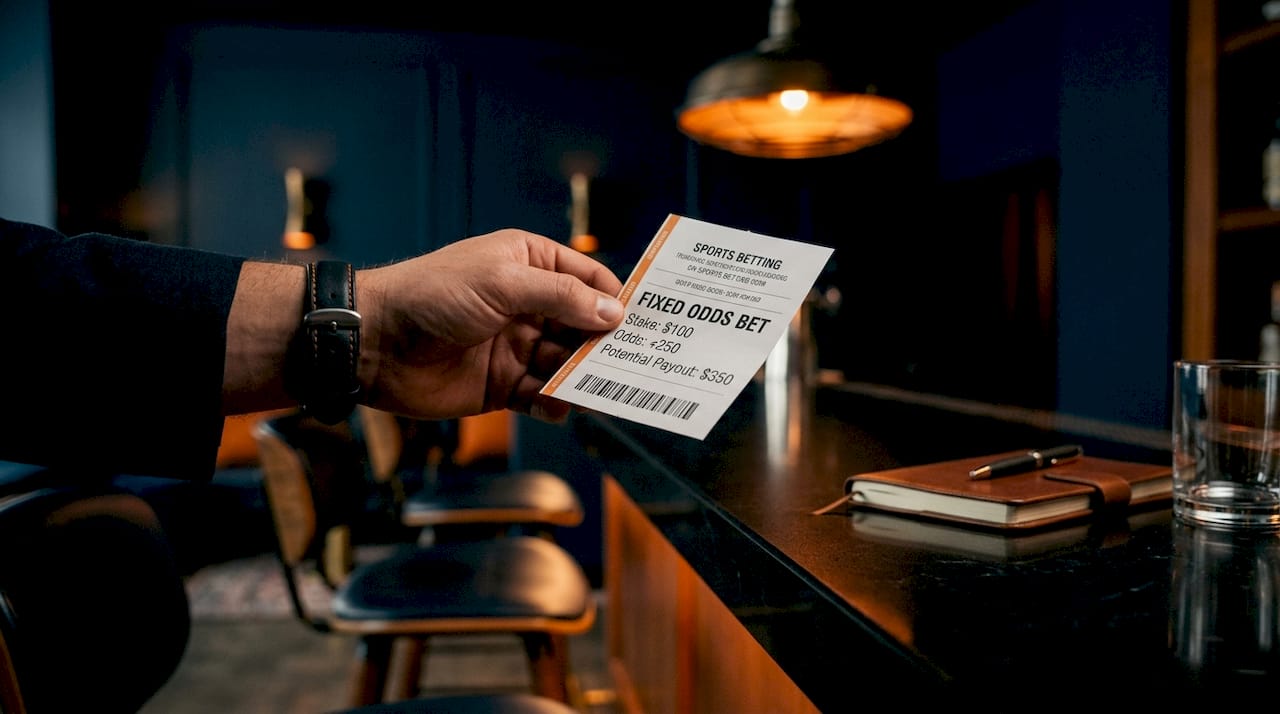
Close-up of sports betting slip with fixed odds

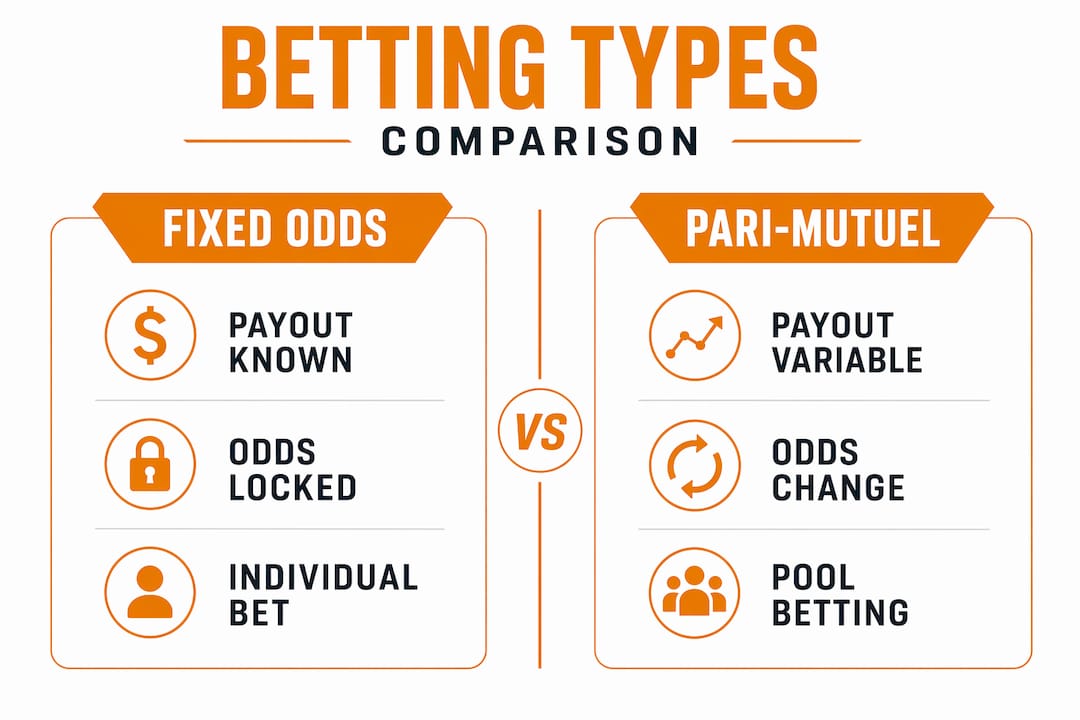
The main alternative is pari-mutuel betting, also called pool or tote betting. In pari-mutuel systems, all bets go into a shared pool, the house takes a commission, and the remaining money is split among winners after the event closes. Your payout is unknown until the pool is finalized. Fixed odds create a bet-versus-bookmaker profile, giving you predictable payouts and tighter bankroll control, while pari-mutuel betting introduces more variance because the pool shifts constantly up to race time.

Here is a direct comparison of the two systems:

FeatureFixed odds bettingPari-mutuel betting
Payout known at bet timeYesNo
Odds change after bet placedNot for your betYes, pool shifts constantly
Who sets the priceBookmakerMarket (other bettors)
Bankroll predictabilityHighLow
Common inSports, soccer, tennisHorse racing, greyhounds

Pro Tip: Place your fixed odds bet early when you believe the odds are at their peak. Once accepted, your price is locked. If the market moves in your favor later, new bettors get the better price, but your original odds still stand.

How do different odds formats work in fixed odds betting?

Reading odds correctly is not optional. Misreading American versus fractional versus decimal odds leads directly to payout confusion, which is one of the most common beginner mistakes in fixed odds betting. Every format expresses the same information differently, and knowing all three gives you an edge on any platform.

Here is what each format means in practice:

  • Fractional odds (common in the UK and horse racing): A price of 4/1 means you win $4 for every $1 staked, plus your $1 stake back. So a $10 bet at 4/1 returns $50 total ($40 profit plus $10 stake).
  • Decimal odds (standard on most European and international platforms): A price of 1.80 means your total return is $1.80 per $1 staked. A $10 bet at 1.80 returns $18 total, meaning $8 profit.
  • American odds (moneyline): Negative numbers show how much you must wager to win $100. Positive numbers show how much you win if you wager $100. A line of +200 means a $100 bet wins $200 profit. A line of -150 means you must bet $150 to win $100 profit.

The CBS Sports guide to betting odds confirms that fractional odds show profit relative to stake, decimal odds show total return per $1 staked, and American odds pivot around the $100 benchmark. Understanding odds formats deeply helps you align your expectations and manage risk before any money moves.

Pro Tip: Convert all odds to decimal format in your head before placing any bet. Decimal odds make it fastest to calculate your total return. Multiply your stake by the decimal price and you have your payout instantly.

Infographic comparing fixed odds and pari-mutuel betting

Where fixed odds betting is used most in sports and horse racing

Fixed odds betting covers nearly every major sport. Soccer, basketball, NFL, MLB, tennis, and MMA all run on fixed odds markets at bookmakers like DraftKings, FanDuel, and BetMGM. The bookmaker sets a price, you accept it, and that price is yours for the life of the bet. This simplicity is why fixed odds dominate sports betting globally.

Horse racing adds an interesting layer. Most bettors associate horse racing with tote or pari-mutuel pools, but fixed-odds horse racing betting locks your price at the moment you submit your wager, just like any other sport. The odds window typically opens around 24 hours before race time. Bets placed before that window opens may receive closing price odds rather than the advertised early price, so timing matters. Fixed odds horse racing is more intuitive for traditional sports bettors because you know your payout upfront, unlike tote betting where the final dividend is a surprise.

Here is a numbered breakdown of the most popular applications:

  1. Soccer match betting: Win, draw, or loss markets with fixed odds locked at bet time. The most widely bet sport globally using fixed odds.
  2. NFL and NBA point spreads: Fixed odds applied to spread markets, where the price is typically -110 on both sides.
  3. Tennis match winner: Simple head-to-head fixed odds markets with clear favorite and underdog pricing.
  4. Horse racing fixed odds: Early price betting with odds locked 24 hours before the race, contrasted with tote pools that settle after the race closes.
  5. In-play sports betting: In-play fixed odds allow fast acceptance of live prices, but once your bet is matched, no upgrades to that price are possible, even if odds shift in your favor seconds later.

Once your bet is accepted, odds changes affect only new bettors. Your locked price is yours, win or lose.

How to place fixed odds bets and strategies that actually work for beginners

Placing a fixed odds bet is straightforward. The strategy behind it takes more thought. Follow these steps to place your first bet correctly, then read the strategic notes below them carefully.

  • Step 1: Choose a licensed sportsbook. Use a regulated platform like DraftKings, FanDuel, or BetMGM. Verify it holds a valid license in your state before depositing.
  • Step 2: Select your sport and market. Navigate to the event you want to bet on. Choose the specific market, such as match winner, total points, or player prop.
  • Step 3: Check the odds format. Confirm whether the platform displays American, decimal, or fractional odds. Switch formats in settings if needed.
  • Step 4: Enter your stake. Type in the amount you want to wager. The platform will display your potential payout based on the locked odds.
  • Step 5: Confirm the bet. Once you submit, the bookmaker accepts your bet and your odds are locked. No changes are possible after acceptance.

Now for the strategy. Fixed odds betting requires accepting a trade-off: you get certainty now, but you may miss out if odds improve later. If odds shorten after you bet, you keep your original price and that is an advantage. If odds lengthen, you forgo the better price. This is the core tension every bettor manages.

For beginners, the most practical approach to safe betting is to set a fixed unit size per bet, typically 1% to 5% of your total bankroll, and never deviate. Fixed odds make this discipline easier because you always know your maximum loss before the event starts. You are never surprised by a pool settling at a fraction of what you expected.

Avoid chasing odds. Many beginners wait for better prices and miss the window entirely, or bet impulsively on live markets where prices move in seconds. Decide your price threshold before the event, place the bet when that price is available, and move on. Discipline beats timing every time.

Key takeaways

Fixed odds betting is the most beginner-friendly betting format because it locks your payout at bet placement, removes payout uncertainty, and supports disciplined bankroll management from day one.

PointDetails
Odds lock at acceptanceYour payout is fixed the moment the bookmaker accepts your bet, regardless of later market moves.
Pari-mutuel is the main alternativePool betting settles after the event; fixed odds give you a known return before it starts.
Three odds formats to masterFractional, decimal, and American odds all express the same payout differently. Learn all three.
Horse racing has a fixed odds windowThe price window opens roughly 24 hours pre-race; bets outside this window may get closing price odds.
Bankroll control is easierPredictable payouts let you set consistent unit sizes and track your betting performance accurately.

My honest read on fixed odds betting after years in the game

I have watched hundreds of beginners walk into sports betting convinced that finding the right pick is the whole job. It is not. The format of your bet matters just as much as the selection itself. Fixed odds betting is the format that gives you the most control, and control is what separates bettors who last from those who blow their bankroll in a month.

The trade-off people underestimate is the early price decision. Locking in odds early feels safe, and often it is. But I have seen bettors lock in 2/1 on a soccer match only to watch the same selection drift to 4/1 by kickoff because of a late team news update. That stings. The counter to this is doing your research before the market opens, not after. If you know the team news, the injury reports, and the form, you can make a confident early price decision instead of guessing.

The other thing beginners get wrong is treating fixed odds as a guarantee of winning. The odds are fixed. The outcome is not. A locked price at 5/1 still loses 5/1 bets most of the time. Fixed odds betting supports smart betting strategy by making your risk predictable, not by making your picks correct. Use the certainty of fixed odds to build a disciplined system. Do not use it as a reason to bet more than you can afford to lose.

— Thomas

Get verified soccer predictions to back your fixed odds bets

https://fixedmatch-house.com

At Fixedmatch-house, we back every fixed odds bet with verified insider analysis and real documented results. Our team has direct contacts inside professional football, and every prediction we publish comes with proof. No guessing. No vague tips. 100% verified picks you can place with confidence on any fixed odds platform. If you are serious about turning fixed odds betting into real, consistent profit, you need predictions that are already proven to win. Check our soccer betting predictions and see exactly what our clients are winning right now. Real results. Real money. MONEY IS FREEDOM! Visit our soccer fixed match tips page and start winning today.

FAQ

What is a fixed odds bet in simple terms?

A fixed odds bet is a wager where the bookmaker locks in your payout odds at the moment your bet is accepted. Your return is set and does not change, regardless of how the odds move afterward.

Can odds change after I place a fixed odds bet?

Odds cannot change for your accepted bet. Bookmakers adjust prices for new bettors, but your locked-in price remains unchanged for the life of your wager.

What is the difference between fixed odds and pari-mutuel betting?

Fixed odds pay a set amount determined at bet placement. Pari-mutuel betting pools all wagers together and divides the pool among winners after the event, so the payout is unknown until the race or event closes.

Which odds format should beginners use?

Decimal odds are the easiest format for beginners because the total return calculation is simple: multiply your stake by the decimal price. Most international platforms allow you to switch formats in account settings.

How do fixed odds bets work in horse racing?

Fixed-odds horse racing locks your price at the time you place the bet, with the odds window typically opening around 24 hours before the race. Bets placed outside this window may receive closing price odds rather than the early advertised price.

Article generated by BabyLoveGrowth

How to Choose Safe Payment Betting Platforms

How to Choose Safe Payment Betting Platforms

A safe payment betting platform is defined as a licensed, regulated operator that uses encryption, identity verification, and secure payment rails to protect every transaction you make. Choosing the wrong platform costs you more than a bad bet. It can cost you your entire deposit, your banking details, and your financial security. Operators like FanDuel, DraftKings, and BetMGM have set the standard in the US market, while UKGC-licensed bookmakers lead in the UK. This guide breaks down exactly how to choose safe payment betting platforms, what payment methods to trust, and how to keep your money protected from the first deposit to the final withdrawal.

What licensing and security certifications should you check?

Licensing is the single most important factor when you evaluate any betting platform. A license from the UK Gambling Commission or a US state regulator like the New Jersey Division of Gaming Enforcement means the operator must meet strict standards for data security, fair play, and customer protection. UKGC-licensed operators are required to follow rules covering encryption, responsible gambling, and transparent payout policies. That regulatory pressure is what keeps your money safe.

Security certifications go hand in hand with licensing. Look for these before you deposit a single dollar:

  • SSL encryption (HTTPS): Every legitimate platform uses HTTPS. If the URL shows HTTP without the S, leave immediately.
  • Two-factor authentication (2FA): This adds a second login step, usually a code sent to your phone, so no one else can access your account even if they have your password.
  • KYC (Know Your Customer) verification: Reputable platforms require ID verification before processing withdrawals. This protects you from fraud and protects the platform from money laundering.
  • Tokenization: Top operators replace your stored card data with a randomized token, so your real card number never sits in their database.

Unlicensed offshore sites skip all of this. They have no legal obligation to pay you out, no regulator to complain to, and no security standards to meet. Layered security controls and regulatory compliance are the real drivers of payment safety, not just which payment method you pick.

Pro Tip: Before you register, search the operator’s name on the UKGC register or your state’s gaming control board website. If they are not listed, do not deposit.

Checking betting platform license on government website

Which payment methods are safest for online betting?

Not all payment methods carry the same risk. The table below compares the most common options across the factors that matter most to your financial safety.

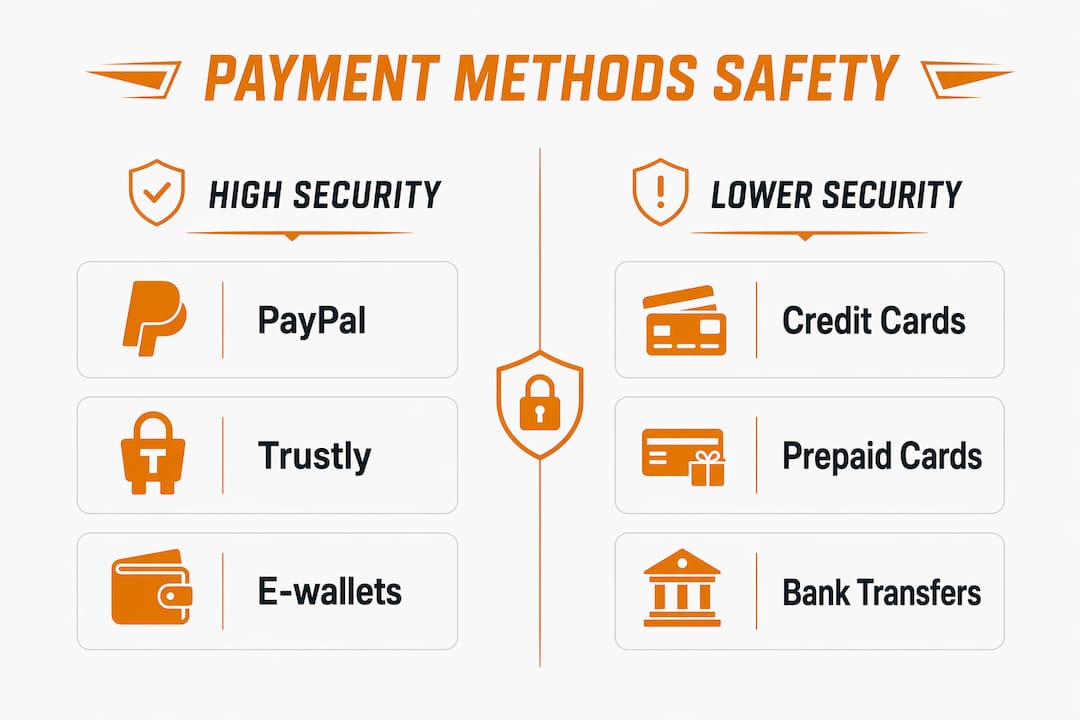
Payment MethodSecurity LevelWithdrawal SpeedCard Data Exposed?
PayPalHigh1 to 3 days (often under 12 hours)No
Trustly (open banking)Very High1 to 2 daysNo
Debit/Credit CardMedium3 to 5 daysYes
SkrillHigh24 to 48 hoursNo
NetellerHigh24 to 48 hoursNo
ACH Bank TransferMedium3 to 5 daysPartial

PayPal processes withdrawals faster than almost any other method at US sportsbooks, often completing payouts in under 12 hours. Speed matters because a faster withdrawal means less time your money sits exposed on a third-party platform.

Infographic comparing payment method security levels

Trustly deserves special attention. Trustly’s open banking approach transfers funds directly from your bank using your verified banking login, so your card details are never shared with the betting site. Regulated US sportsbooks commonly use Trustly for exactly this reason. It removes the card data exposure risk entirely. This is the most underrated security advantage in online betting payments.

E-wallets like Skrill and Neteller act as a buffer between your bank and the betting site. The platform never sees your real banking details. The trade-off is that some operators charge fees for e-wallet deposits, and a few restrict bonuses for e-wallet users, so read the terms before you commit.

Credit cards carry the highest card data exposure risk because your full card number passes through the operator’s system. Debit cards are slightly safer but still share card data. If you use a card, confirm the platform uses tokenization to reduce that risk.

Pro Tip: Use PayPal or Trustly as your primary deposit method whenever the platform supports them. Reserve card payments only for platforms where no e-wallet or open banking option exists.

How do withdrawal policies and platform controls affect your payment safety?

Withdrawal policies are where most bettors get caught off guard. Follow these steps to protect yourself before and after you deposit.

  1. Confirm the same-method withdrawal rule. Most regulated operators require you to withdraw via the same method you used to deposit. This is an anti-money laundering compliance requirement, not an inconvenience. It means your money goes back to the verified source, not to a random account.
  2. Check the withdrawal processing time in writing. Look at the platform’s banking page before you register. If they list vague timeframes like “up to 10 business days” for standard methods, that is a red flag.
  3. Use deposit limits from day one. The UK Gambling Commission introduced mandatory gross deposit limits starting in 2026 to protect bettors from overspending. Even if your platform does not require it, set your own deposit limit in your account settings. This is one of the most practical financial safety tools available.
  4. Activate self-exclusion if you need a break. Tools like GAMSTOP in the UK prevent you from logging in and betting during your exclusion period. GAMSTOP and similar exclusion tools do not touch your money. Licensed operators return your remaining balance when you self-exclude, so your funds stay protected.
  5. Document every transaction. Screenshot your deposit confirmations and withdrawal requests. If a dispute arises, you need a paper trail. Regulated platforms have dispute resolution processes, but you need evidence to use them.

What steps can you take to verify and maintain payment safety?

Verification is not a one-time task. It is an ongoing habit that keeps your money safe every time you bet.

  • Check the SSL certificate before every login. Click the padlock icon in your browser’s address bar. It should show the operator’s verified organization name, not just a generic certificate. A missing padlock means your connection is not encrypted.
  • Unlink your bank account when you are not actively betting. Regulated US sportsbooks allow you to unlink bank accounts when idle. This limits your exposure if the platform ever suffers a data breach.
  • Never share payment details across accounts. Use one dedicated payment method per betting platform. If one platform is compromised, your other accounts remain protected.
  • Monitor your bank and e-wallet statements weekly. Unauthorized charges on betting-linked accounts often appear as small test transactions before a larger fraud attempt. Catching them early stops the damage.
  • Research the platform’s reputation on independent forums. Sites like Reddit’s r/sportsbook and Trustpilot carry real user reports on payout problems and security incidents. One pattern of complaints about withheld withdrawals is enough reason to walk away.

Pro Tip: Set a Google Alert for the betting platform’s name plus the word “scam” or “withdrawal.” You will get notified the moment other users start reporting problems, before it affects your account.

How to choose between platforms and payment methods for your betting needs

Matching the right platform to the right payment method depends on your location, your priorities, and how often you bet. Use this table as your decision framework.

PriorityRecommended Platform TypeBest Payment Method
Maximum securityUKGC or state-licensed operatorTrustly or PayPal
Fastest withdrawalsMajor US sportsbook (FanDuel, DraftKings)PayPal
Lowest feesLicensed operator with e-wallet supportSkrill or Neteller
Responsible gambling toolsUKGC-licensed operatorAny method with deposit limits active
Bonus eligibilityCheck terms per operatorDebit card (e-wallets often excluded)

US bettors must confirm the platform holds a license in their specific state. DraftKings operates in over 20 states, but its license in New Jersey does not cover you in Texas. Jurisdiction matching is non-negotiable for legal protection. UK bettors should stick to UKGC-licensed operators exclusively, since offshore sites have no obligation to honor your withdrawals or protect your data.

Speed and fees pull in opposite directions. PayPal is fast but not universally available. Trustly is very secure but withdrawal timelines vary by operator. Skrill and Neteller are fast and private but sometimes carry deposit fees of 1 to 2 percent. There is no perfect option. The right choice is the one that balances your security needs with the practical realities of your betting frequency and deposit size.

Only consider promotional offers after you have confirmed the platform’s safety credentials. A 100% deposit bonus from an unlicensed site is worthless if they never pay you out. Safety first, bonuses second. Always. You can also learn more about safe vs risky bets before committing to any platform or offer.

Key takeaways

Safe payment betting requires licensed platforms, layered security controls, and verified payment methods working together. No single factor alone is enough.

PointDetails
License verification is firstAlways confirm UKGC or state licensing before depositing any funds.
Open banking beats card paymentsTrustly and PayPal avoid card data exposure, reducing your fraud risk significantly.
Same-method withdrawals protect youWithdrawing via your deposit method is a compliance rule that keeps your money traceable.
Deposit limits are a safety toolSet voluntary limits even when not required; UKGC made them mandatory in 2026.
Ongoing monitoring mattersUnlink idle accounts and check statements weekly to catch fraud early.

Why payment type alone will never be enough

I have spent years watching bettors obsess over which payment method to use while completely ignoring whether the platform holding their money is even licensed. That is the wrong order of priorities. The payment method is the last line of defense. The platform’s licensing and security infrastructure is the first.

Here is what I have seen work in practice. Bettors who use PayPal or Trustly on a licensed platform and set deposit limits from day one almost never face serious financial problems. Bettors who chase the highest bonus on an offshore site and deposit via card are the ones who end up in forums asking why their withdrawal has been pending for 60 days. The pattern is consistent.

The uncomfortable truth is that no payment method makes an unlicensed platform safe. Trustly on a scam site is still a scam. PayPal on a licensed platform is genuinely protected. The operator’s credentials determine your safety ceiling. The payment method just determines how close you get to that ceiling.

Use responsible gambling tools proactively, not reactively. GAMSTOP, deposit limits, and spending alerts exist because the betting industry knows that financial pressure leads to bad decisions. Using these tools is not a sign of weakness. It is the most rational thing a serious bettor can do. If you want to bet smart, start with verified betting strategies that account for both platform safety and financial discipline.

— Thomas

Get verified betting tips with safe payment options built in

At Fixedmatch-house, we do not just give you predictions. We give you 100% verified soccer betting tips backed by insider contacts inside professional football. REAL tips. REAL wins. REAL proof. Every prediction comes with documented results and client testimonials so you know exactly what you are getting before you pay. We work only with platforms that support safe payment methods so your money moves securely from deposit to payout. No scams. No offshore risk. Just guaranteed results from a team that knows the game from the inside.

https://fixedmatch-house.com

If you are serious about profit, start with our soccer betting predictions and see the proof for yourself. Or check our daily betting tips for today’s highest-confidence matches. MONEY IS FREEDOM. Make yours count.

FAQ

What makes a betting platform safe for payments?

A safe betting platform holds a valid license from a recognized regulator like the UKGC or a US state gaming authority and uses SSL encryption, 2FA, and KYC verification. Layered security controls combined with regulatory compliance are the defining factors, not the payment method alone.

Is PayPal the safest payment method for online betting?

PayPal is one of the safest options because it does not share your card or bank details with the betting site and processes withdrawals faster than most alternatives. Trustly offers comparable privacy through open banking and is considered equally secure.

Why do betting sites require the same withdrawal method as the deposit?

Regulated operators enforce same-method withdrawals to comply with anti-money laundering laws, which require funds to return to their verified source. This rule protects you by making it harder for fraudsters to redirect your winnings.

Trustly is an open banking payment provider that authenticates transfers using your bank login instead of sharing card details. Trustly’s pay-by-bank approach reduces fraud risk and is widely used by regulated US sportsbooks as a secure deposit and withdrawal option.

How do deposit limits protect my money on betting platforms?

Deposit limits cap how much you can fund your account within a set period, preventing impulsive overspending. The UKGC made gross deposit limits mandatory for licensed operators in 2026, and responsible gambling tools like these are proven to reduce financial harm for bettors.